Khatian, Dag, Porcha, Namjari, Mouza: Land Record Terms
Buying, inheriting or mutating land in Bangladesh means reading records full of words like khatian, dag, porcha, namjari, dolil and mouza. This glossary explains each term in plain English, in the order you meet them: first the map and the record, then the surveys that produced the records, then the documents and procedures of a transfer.
The map and the record
- Mouza
- The smallest revenue unit, usually one village or part of one, with a fixed boundary and a number (JL number) within the upazila. Every survey map and every khatian belongs to a mouza, so the mouza name and number are the first thing to find on any land document.
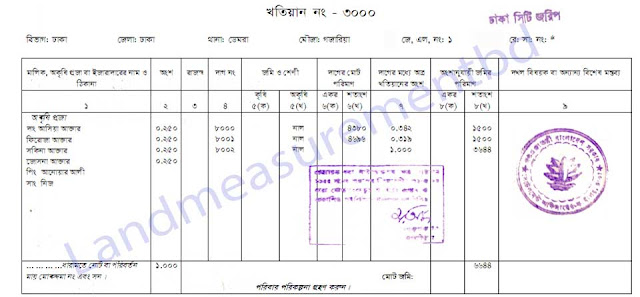
- Khatian
- The record of rights prepared during a survey. One khatian lists the owner or owners, the dag numbers they hold in the mouza, the area of each dag, the type of land and the rent. Khatians are numbered within the mouza, and a plot is fully identified by mouza, khatian number and dag number.
- Dag (plot) number
- The number of one plot on the mouza map. Each parcel of land drawn on the map during a survey gets its own dag number, and the khatian refers to the plot by that number. A khatian may cover several dags, and one dag can be shared among several khatians.
- Chhuta dag
- A dag number that was left out or added after the main numbering of the mouza map, so it does not fall in the ordinary sequence. It is a valid plot, but it needs extra care when matching the map to the khatian.
- Porcha
- A certified copy of a khatian, or the draft khatian handed to the landholder during a survey for checking. In everyday speech "porcha" and "khatian" are used interchangeably, and buyers ask for the porcha of each survey.
- Chita
- The surveyor's field book in which each plot is sketched and its measurements noted while the mouza map is being drawn. The chita is the raw material from which the map and later the khatian are prepared.
- Khanapuri
- The stage of a survey in which the columns of the khatian form are filled in: owner, dags, areas and rent. It follows the drawing of the map and comes before the record is checked with the people concerned.
- Bujharat
- The stage after khanapuri in which the draft entries are explained to the landholders on the spot so they can point out mistakes before the record is attested and published.
The surveys
- CS khatian
- The Cadastral Survey record, prepared under the Bengal Tenancy Act between about 1888 and 1940 across Bengal district by district. It is the oldest complete plot-by-plot record for most of Bangladesh, and the chain of title for a plot is normally traced from it.
- SA khatian
- The State Acquisition record, prepared after the State Acquisition and Tenancy Act of 1950 abolished the zamindari system. The SA operation of roughly 1956 to 1962 was largely a paper revision of the CS record that recorded tenants as direct holders under the government rather than a fresh field survey.
- RS khatian
- The Revisional Survey record, started around 1965 and carried out district by district over the following decades to correct the errors of the SA record with a new field survey. In many districts the RS khatian is the latest final record.
- BS or City Jarip khatian
- The Bangladesh Survey, the newest round of field survey, begun in the late 1990s and still in progress in places. In Dhaka the same operation is called the City Jarip (metropolitan survey). Where it has been finally published it supersedes the RS record.
Documents
- Tofsil (schedule)
- The part of a deed that identifies the land: district, upazila, mouza, khatian numbers of each survey, dag numbers, the area being transferred and the boundaries on four sides. Every figure in the tofsil should match the khatians and the map.
- Dolil (deed)
- Any written instrument that is legal evidence of a right. In land matters it usually means the registered deed of sale, gift, exchange or partition executed before the sub-registrar under the Registration Act.
- Baynama
- A deed of sale, or the agreement for sale (bayna) that precedes it in which the buyer pays earnest money and the seller undertakes to complete the transfer within an agreed time.
- Dakhila
- The rent receipt issued by the union land office when land development tax (khajna) is paid. An up-to-date dakhila in the seller's name is one of the first papers a buyer asks to see.
- DCR (Duplicate Carbon Receipt)
- The receipt issued by the land office for fees paid in a mutation (namjari) case or for other charges. It is proof that the fee for the new khatian was paid.
- Khajna
- The annual land development tax paid to the government for holding land. Arrears are recovered as a public demand, so a buyer checks that khajna is paid up to date.
- Kabuliyat
- A written acceptance of a tenancy by the tenant, historically given in exchange for the landlord's patta. Old kabuliyats still turn up in chains of title from before 1950.
- Hukumnama
- A written order, in land matters typically an order from a court or a revenue officer directing that something be done, such as a name recorded or possession delivered.
- Dakhalnama
- A certificate of delivery of possession, most often issued after a court sale or a partition decree to confirm that the holder was put in possession of the land.
Procedures and people
- Namjari (mutation)
- The procedure by which a new owner, after purchase, gift or inheritance, has their name recorded in place of the previous holder and receives a new khatian from the assistant commissioner (land). Until namjari is done the government record still shows the old owner.
- Joma kharij
- The separation of a holding: part of a khatian is split off into a new khatian with its own rent, usually as the outcome of a namjari case when a buyer takes only some of the seller's land.
- Farayez
- The distribution of a deceased person's estate among heirs according to the applicable law of inheritance. A farayez statement shows each heir's share and is needed when inherited land is mutated or sold.
- Warish
- An heir. A warish certificate from the union parishad or municipality lists the legal heirs of a deceased landholder and is used in namjari and in sales of inherited land.
- Amin
- The survey official (or a licensed private surveyor) who measures land with chain and tape, draws plots and identifies boundaries. An amin is called in to locate a dag on the ground before a purchase or in a boundary dispute.
- Kistwar
- The first stage of a survey, in which the amin measures each plot in the field and draws the mouza map. Khanapuri and bujharat follow it.
- Jamabandi
- The rent roll: the register of holdings in a mouza showing each holder and the rent payable. The word is used in the land office for the register from which khajna is assessed.
Frequently asked questions
What should I check before buying land?
Ask for the CS, SA, RS and (where published) BS khatians and follow the chain of ownership from one to the next; make sure the dag numbers in the deed match the khatians and the mouza map; confirm the seller has completed namjari in their own name; and see a recent dakhila showing khajna paid up to date.
What is the difference between a khatian and a porcha?
None in practice. Khatian is the record itself and porcha is a copy of it (or the draft given during a survey), but people use both words for the same paper.
Why does one plot have several dag numbers?
Each survey redrew the mouza map and renumbered the plots, so a plot has a CS dag, an SA dag, an RS dag and possibly a BS dag. The deed's tofsil should list all of them.
Is namjari compulsory after buying land?
Yes. Registration transfers the title, but until mutation is done the land office record and the khajna receipt stay in the seller's name, which causes problems on resale and in any dispute.
How is the area in a khatian written?
In acres to four decimal places: 0.1650 acre is 16.5 decimal. See the land measurement method page for the units.
Comments
And Do you want to know about What time does Big Lots Store Open? and What time does Big Lots Store Close?
Big lots customer service Number and Big Lots Store Locations Near Me.
If you don’t know so don’t worry my friends, cause Here we have explained all Big lot survey, Big lots rewards,
that would help you to save your time and fuel. There is no necessary to go visit Big Lots Store yourself.
big lots survey number
big lots transaction number on receipt
biglotsurvery
Post a Comment